




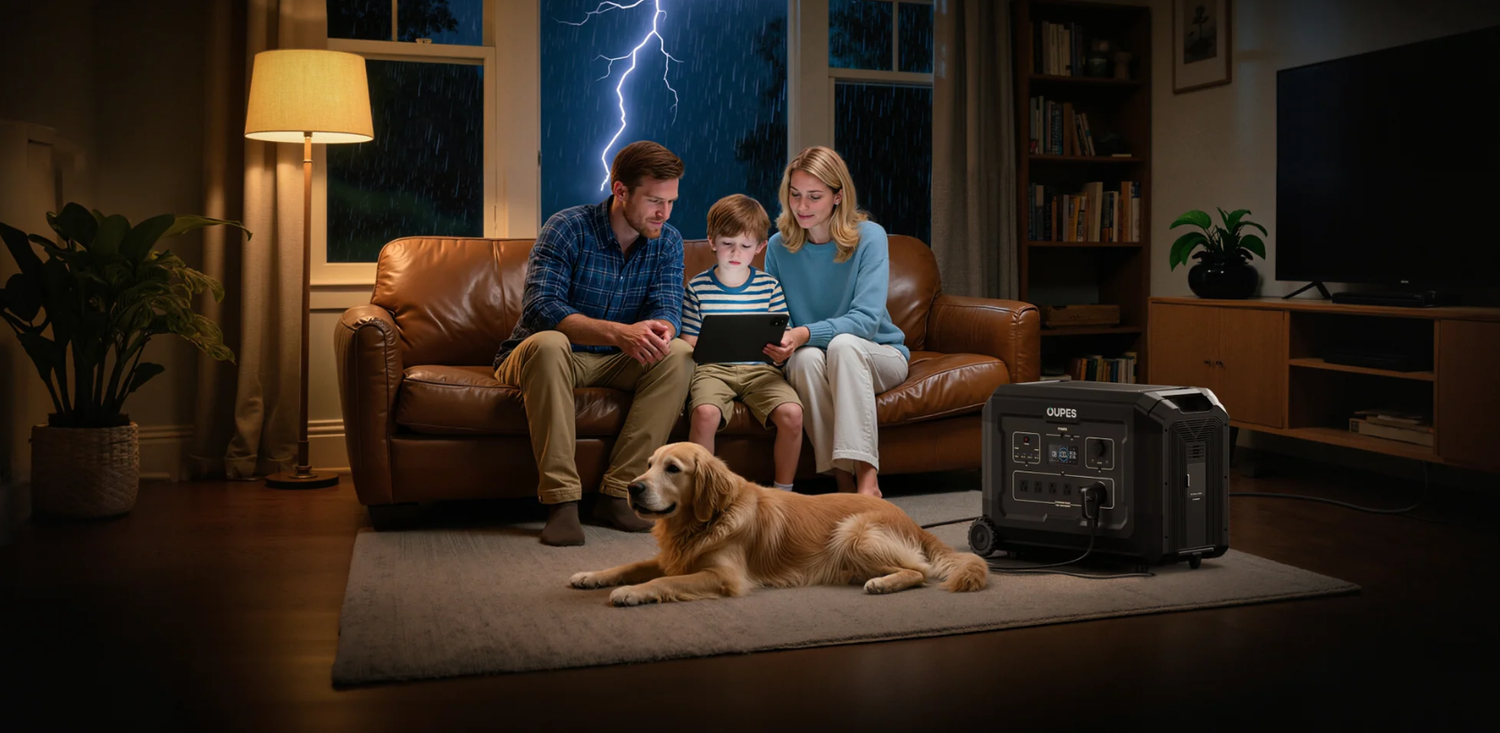
Lightning storms can knock out electricity in several different ways, and not all of them involve a dramatic direct strike to a power line. In the UK, thunderstorms can bring lightning, torrential rain, hail, sudden gusty winds, and localised flooding, all of which can affect electricity networks and the homes connected to them.[1][2] The Met Office also notes that lightning can cause power cuts and disrupt other utilities and services, while official warning pages say power cuts may occur and mobile phone services can also be affected during severe weather.[3][4]
That matters because many people assume every storm-related outage has the same cause and the same level of risk. It does not. Some outages are brief, automatic protection events that restore power in seconds. Others happen because equipment is damaged, debris hits lines, or flooding affects network assets, which can take much longer to fix. Understanding the difference helps you respond better, protect your home electronics, and choose the right level of backup power for your household.
Table of Contents
- Why lightning storms can cut power
- Cause 1: Direct lightning strikes on power equipment
- Cause 2: Protective switching and automatic shut-offs
- Cause 3: Trees, branches, and debris hitting overhead lines
- Cause 4: Torrential rain, flooding, and water-related faults
- Cause 5: Power surges and local electrical disruption
- What to do when the power goes out during a lightning storm
- Why backup power matters in storm season
- Detailed OUPES options for storm-outage backup
- Bottom line
- References
- FAQ
Why lightning storms can cut power
A thunderstorm is not a single hazard. It is a cluster of hazards happening at once. The Met Office explains that UK thunderstorms can produce lightning, large hail, gusty winds, and torrential downpours, all of which can damage property and disrupt transport and infrastructure.[1] From an electricity-supply point of view, that means power can fail because equipment is struck, because the network shuts sections down to protect itself, because branches hit lines in strong gusts, or because water and flooding interfere with substations, cables, or related assets.[2][5][6]
This is why one lightning storm may cause a blink-and-you-miss-it interruption, while another leaves a neighbourhood without power for hours. The underlying mechanism matters.
Cause 1: Direct lightning strikes on power equipment
The most obvious cause is a direct or very near lightning strike affecting electricity equipment. UK Power Networks states that lightning can sometimes damage electrical equipment and cause power cuts.[5] That includes overhead lines and other exposed parts of the electricity network, which are naturally more vulnerable during severe thunderstorms.
To reduce the impact, utilities use protective hardware such as lightning diverters and other resilience measures. UK Power Networks says it uses lightning diverters on overhead lines to reroute the energy from a strike safely to ground and reduce the effect on customers.[5] That protection helps, but it does not eliminate outages entirely. If a strike is severe enough or lands in the wrong place, equipment can still be damaged and supply can still be interrupted.
In practical terms, a direct strike is one of the fastest ways to turn a normal thunderstorm into a local power-cut event. It is also one reason why lightning-related outages can be highly localised, affecting one street or district while nearby areas remain on supply.
Cause 2: Protective switching and automatic shut-offs
Not every power cut during a lightning storm means something has been destroyed. Sometimes the network turns itself off on purpose to prevent worse damage. UK Power Networks explains that automatic switches can turn power off if lightning strikes overhead lines, wait a few seconds, and then turn power back on again.[5] It also says this can happen if tree branches or debris briefly touch the power lines and trigger the same protection logic.[5]
That is an important point for households because a brief power dip, a short outage, or a rapid off-on sequence may actually be the system doing its job. Utilities often call this kind of network behaviour “self-healing” or automatic restoration. The interruption is inconvenient, but the goal is to prevent a transient fault from becoming a larger and longer outage.[5]
| Type of Event | What Happens | What It Means for You |
|---|---|---|
| Brief automatic trip | Power cuts out for seconds, then returns | The network may have cleared a temporary fault automatically |
| Repeated short interruptions | Power blinks multiple times | Protection equipment may be responding to repeated instability |
| Longer outage | Power does not return quickly | The fault may need physical repair by engineers |
Cause 3: Trees, branches, and debris hitting overhead lines
Lightning storms are often not only electrical events. They are also wind events. The Met Office warns that thunderstorms can bring sudden gusty winds, and National Grid says power cuts are more likely during severe weather on distribution networks that serve homes and businesses.[1][6]
That matters because branches, loose debris, and vegetation can contact overhead lines even if lightning itself does not land directly on the network. UK Power Networks explicitly says that if tree branches or debris briefly touch power lines, automatic switches can operate and interrupt supply.[5] In stronger events, the contact may do more than cause a brief interruption. It can create a fault that requires crews to inspect and repair damage before supply is restored.
This is one reason lightning-storm outages sometimes feel random from a customer point of view. The power cut may seem to happen “because of lightning,” but the real immediate cause may have been wind-driven vegetation or debris.
Cause 4: Torrential rain, flooding, and water-related faults
Another major cause is not lightning itself but the intense rainfall that often comes with thunderstorms. The Met Office says thunderstorms can bring short-lived torrential rain and hail, and its severe-weather guidance notes that flooding of homes and businesses can happen quickly during some warning events, with power cuts also possible.[1][4] National Grid also says severe weather planning includes putting temporary generators and flood defences on standby to help protect the system and restore supplies more quickly when needed.[6]
Water is a problem because electricity equipment must stay dry and secure. Substations, cable routes, outdoor cabinets, and other network assets can all be affected if rain intensity is high enough or if drainage is overwhelmed. Even where the storm itself is highly localised, one flooded low-lying asset can interrupt supply to a wider area.
For households, this means the cause of a storm-related outage is sometimes indirect. The thunderstorm may trigger a chain of events in which rain and flooding do the final damage rather than the lightning strike itself.
Cause 5: Power surges and local electrical disruption
Lightning storms can also cause surge-related disruption even when the grid stays mostly intact. The Met Office advises unplugging non-essential appliances before a thunderstorm if they are not already protected, because lightning can cause power surges.[7] A surge does not always mean the whole home loses power, but it can still affect sensitive electronics, routers, chargers, TVs, and other connected devices.
This is important because not every storm-related electrical problem looks like a total blackout. Sometimes the lights stay on, but electronics reset, internet drops, or a device fails after a storm. That is still part of the larger lightning-storm risk picture. From a preparedness point of view, surge damage and short cuts often belong in the same conversation.
What to do when the power goes out during a lightning storm
The safest response depends on whether the storm is still active. During the thunderstorm itself, the Met Office says to stay indoors as much as possible, avoid using the landline unless it is an emergency, and avoid downed power lines or broken cables after the storm.[7] It also advises that if you are in a car during thunder and lightning, staying inside the vehicle with the windows up is usually safer than standing outside.[7]
If the power does go out, Met Office power-cut advice recommends switching off electrical appliances that should not be left unattended, leaving one light on so you know when supply returns, checking whether your neighbours are affected, and calling 105 for information in England, Scotland, and Wales.[8][9]
- unplug non-essential or sensitive electronics if safe to do so
- leave a single light on so you can see when power returns
- avoid touching downed cables or broken electrical equipment
- check whether the outage is only in your home or affects nearby properties
- use torches or battery lighting instead of risky improvised lighting
- call 105 or check your network operator’s outage information
If the outage is only in your home, it is also worth checking whether your trip switch has activated, as Met Office guidance specifically notes.[8] But if there is any visible storm damage, do not take chances with electrical equipment.
Why backup power matters in storm season
Storm-related power cuts are often short, but not always. Even brief interruptions can matter if they take out broadband, phones, work devices, refrigeration, or lighting late in the evening. That is why a backup power plan is increasingly practical for UK households, especially in areas that see repeated storm-driven cuts or where home working makes electricity continuity more important than it used to be.
The Met Office’s severe-weather advice says people cope better with power cuts when they prepare in advance, and specifically lists torches, batteries, and a mobile phone power pack among the essentials.[8] The logic scales up naturally: for some homes, a small power bank is enough; for others, a larger portable power station makes more sense because it can support routers, lights, laptops, charging, and selected appliances rather than just a phone.
Detailed OUPES options for storm-outage backup
Using the linked OUPES product pages, the easiest way to think about the four units below is by backup role: compact essentials support, stronger medium-load backup, and larger home-resilience support.
| OUPES Model | Rated Capacity | Rated Output | Best Fit in a Lightning-Storm Power Cut |
|---|---|---|---|
| OUPES Mega 1 | 1,024Wh | 2,000W | Routers, phones, lights, laptop work, compact essentials backup |
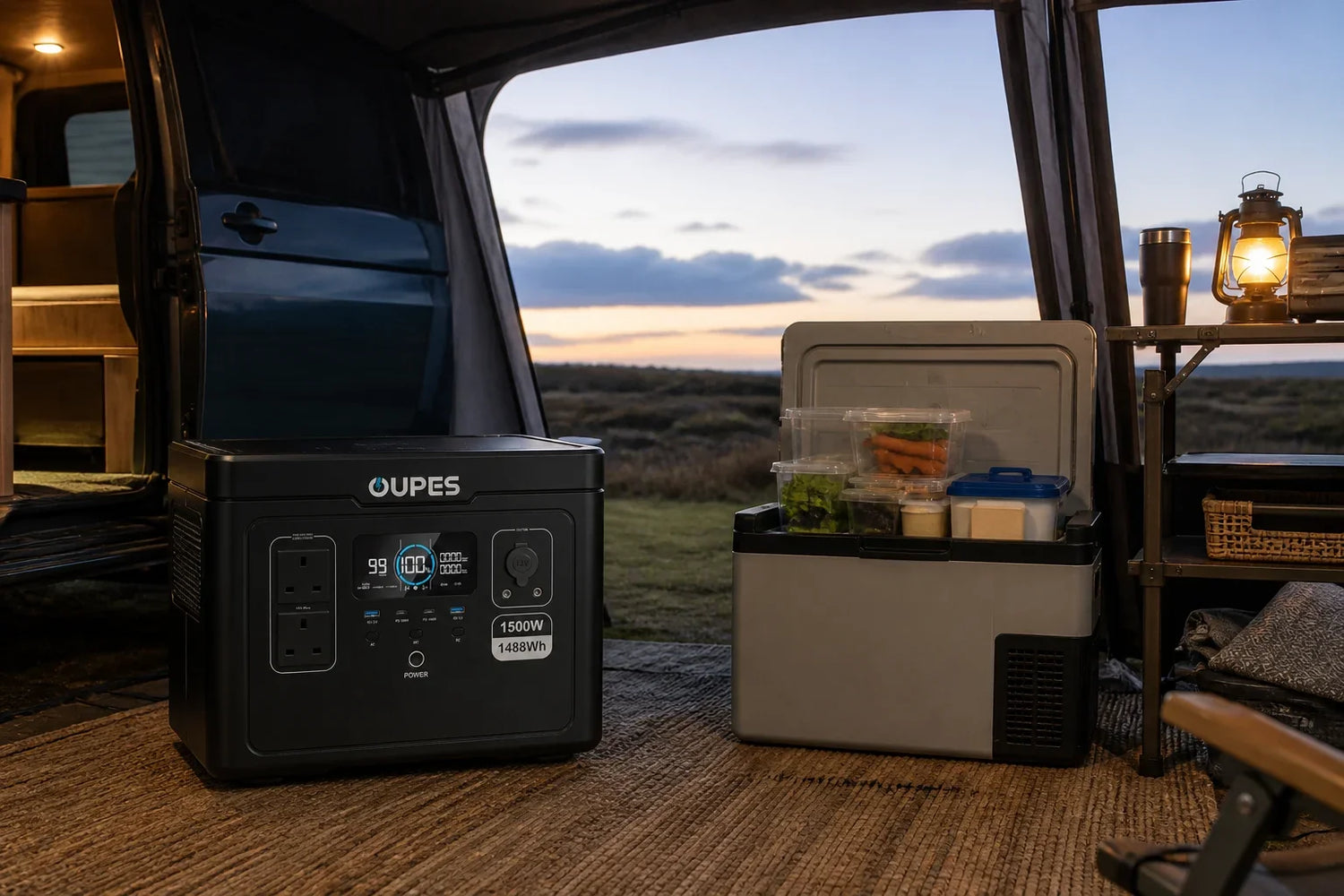
| OUPES Exodus 1500 | 1,488Wh | 1,500W | Longer essentials backup with moderate appliance headroom |
| OUPES Exodus 2400 | 2,232Wh | 2,400W | Family homes, work-from-home resilience, longer runtime needs |
| OUPES Mega 3 | 3,072Wh | 3,600W | Larger backup plans, heavier loads, broader home resilience |
OUPES Mega 1: the fast, compact essentials option
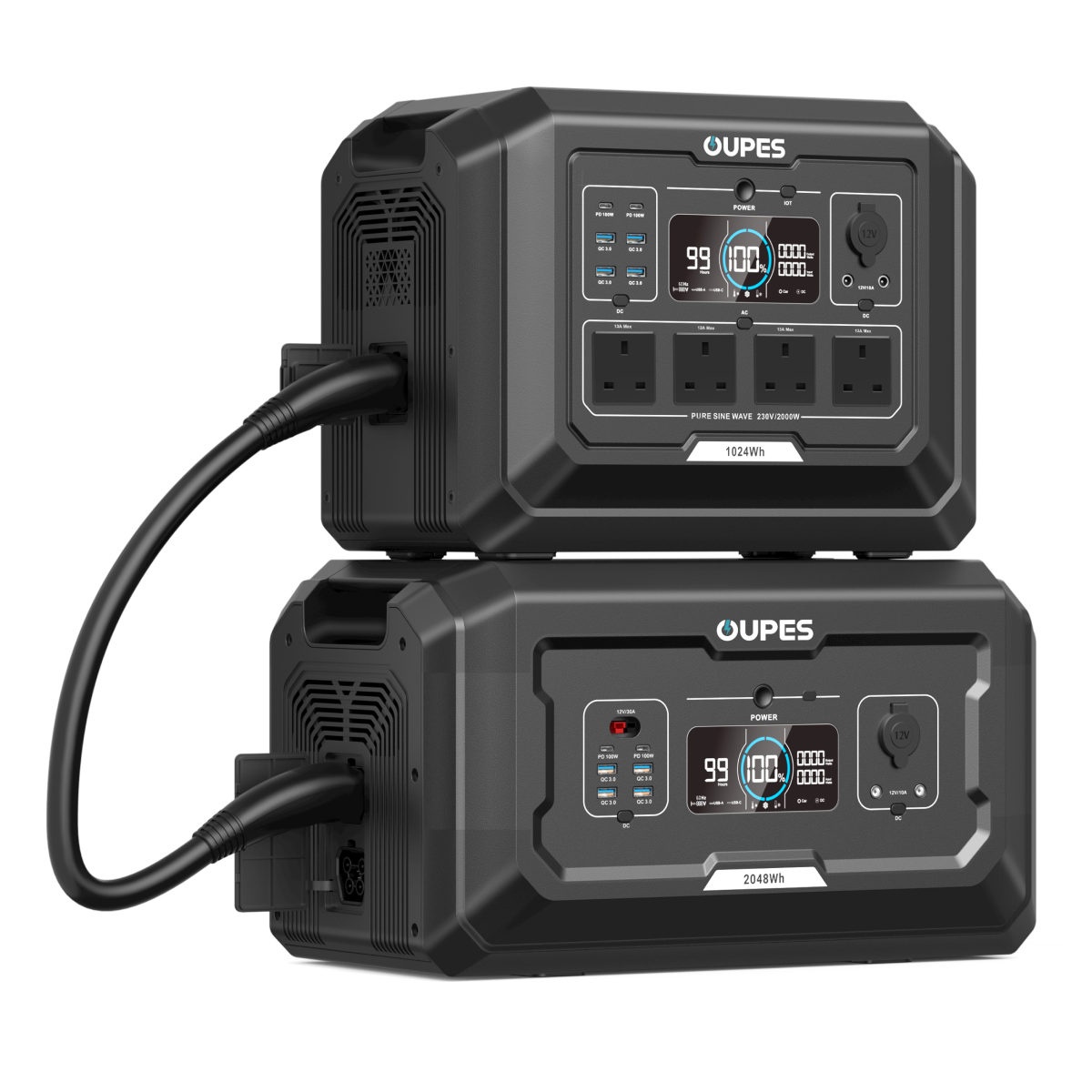
The OUPES Mega 1 is listed at 1,024Wh capacity, 2,000W continuous output, and 4,500W surge. The page also says it has 13 outputs, can expand up to 5,120Wh with two B2 battery packs, and supports multiple charging modes including 1,400W AC input, 800W solar input, and up to 2,200W AC + solar input. OUPES lists charging examples of about 58 minutes on 1,400W AC and about 36 minutes on 2,200W AC + solar.[10]
In storm-season terms, Mega 1 is a strong fit for households that want to keep communications and basic comfort loads going without moving into a heavier system. It suits routers, phones, laptops, small lighting setups, and other “keep the home functioning” essentials.
OUPES Exodus 1500: more runtime without going oversized
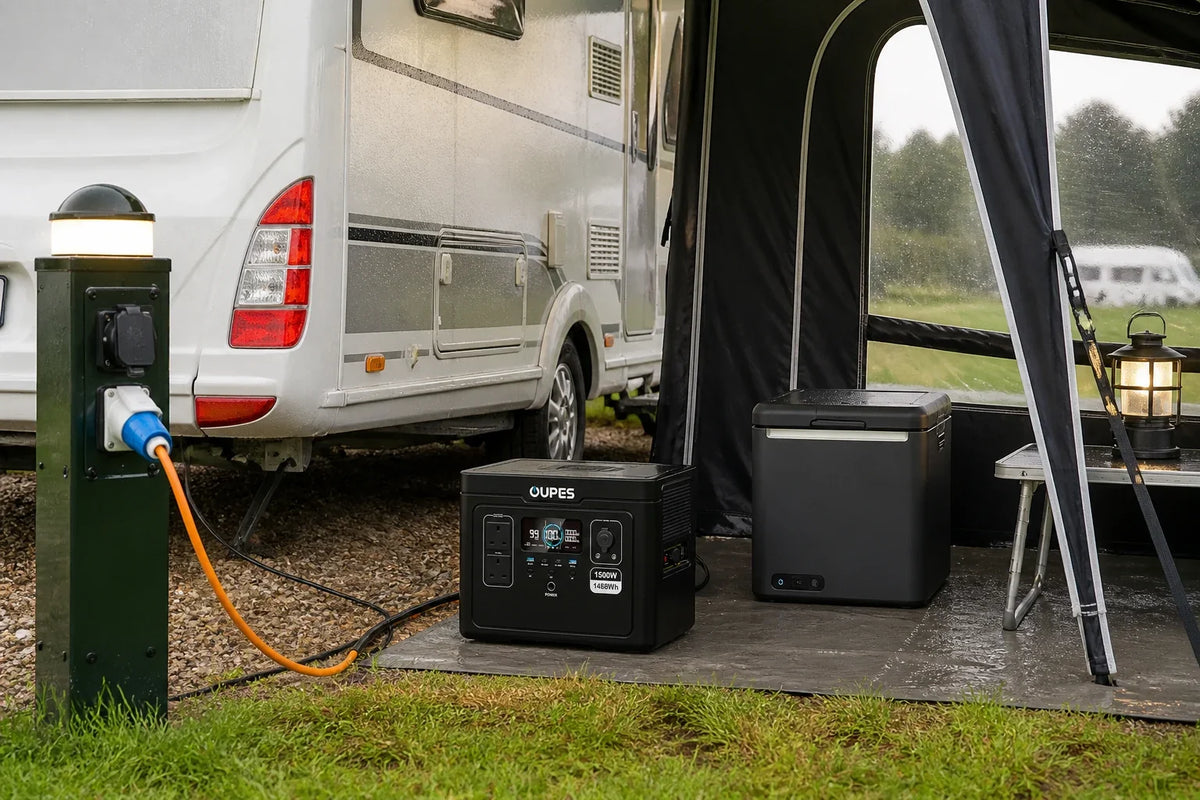
The OUPES Exodus 1500 is listed at 1,488Wh capacity with a 1,500W AC pure sine wave inverter and 1,700W Boost Mode. OUPES also lists 10 outputs, 4 ways to recharge, instant UPS backup under 20ms, a 1,280W max input charging speed, and a listed net weight of 30.5 lbs. The page also states a LiFePO4 battery rated for 3,500+ life cycles to 80%.[11]
This model makes sense for households that need more runtime than a compact unit offers, but do not need a large, high-output platform. It is well suited to longer broadband support, device charging, lighting, and moderate home-backup use during evening or overnight power cuts.
OUPES Exodus 2400: balanced home-backup depth
The OUPES Exodus 2400 is listed at 2,232Wh capacity, 2,400W output, and a 2,600W Boost Mode. The product page also highlights a full AC recharge in about 1.5 hours with 1,400W max AC input, and positions the unit for home backup, off-grid life, and higher-demand use cases.[12]
For UK households worried about repeated thunderstorm-related outages, Exodus 2400 is a strong middle-to-upper-tier option. It is easier to justify when the question becomes not just “Can I charge my phone?” but “Can I keep the broadband, laptops, lights, and selected appliances running for a more meaningful period?”
OUPES Mega 3: the strongest of the four for heavier backup plans
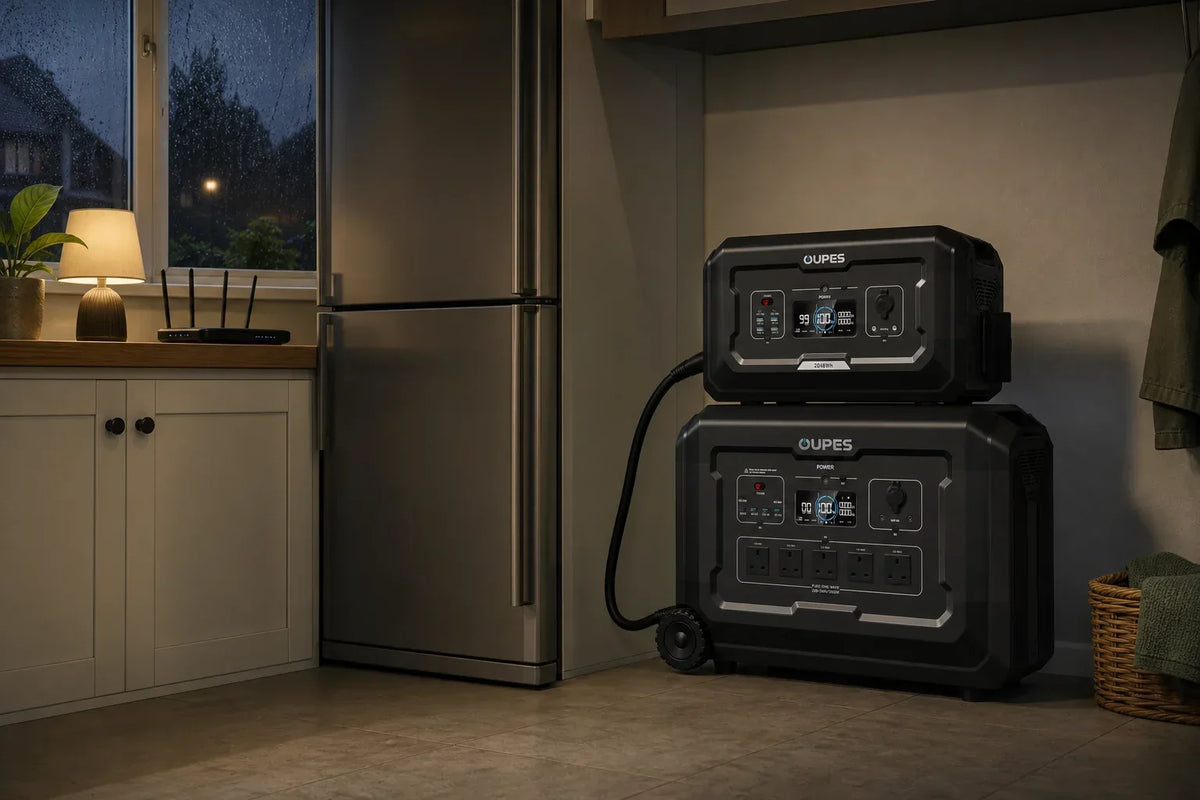
The OUPES Mega 3 is listed at 3,072Wh capacity, 3,600W AC pure sine wave output, and 7,000W surge. OUPES also lists 16 outputs, 3,900W max AC + solar input, recharge to full in about 1 hour, expansion up to 15.36kWh with six B2 batteries, and a LiFePO4 battery rated for 3,500+ cycles to 80%.[13]
This is the model for households that want a larger storm-resilience plan rather than a simple emergency gadget. If your goal is broader backup across more loads, longer cuts, or a more robust home-readiness setup, Mega 3 is the clearest step up among the four linked units.
Bottom line
Power outages during lightning storms can happen for several reasons: direct strikes can damage equipment, automatic protection can shut parts of the network off, branches and debris can hit overhead lines, and torrential rain or local flooding can interfere with electrical infrastructure.[1][3][5][6] That is why two storms that look similar from the window can create very different outage experiences.
For households, the practical response is to prepare in advance: take warnings seriously, unplug sensitive non-essential devices if needed, stay away from damaged cables, use 105 if the power goes off, and have a realistic backup plan for lights, broadband, phones, and essential equipment.[7][8][9] If you do that, a lightning-storm power cut becomes something you manage, not something that completely manages you.
References
- Met Office — Stay safe in thunder and lightning
- Met Office — Community resilience: thunderstorms and lightning
- UK Power Networks — How does lightning affect power supplies?
- Met Office — Weather warnings and expected impacts
- Met Office — Power surges, broken cables, and storm safety
- National Grid — 5 ways we keep the electricity network protected from storms
- Met Office — Unplugging appliances and avoiding downed cables
- Met Office — Power cut preparation and storm safety advice
- Power Cut 105 — Free UK power-cut reporting service
- OUPES Mega 1 official product page
- OUPES Exodus 1500 official product page
- OUPES Exodus 2400 official product page
- OUPES Mega 3 official product page
FAQ
1. Can lightning really cause a power cut even if it does not hit my house?
Yes. Lightning can damage network equipment or cause automatic protective switching on overhead lines, which can interrupt supply to homes well away from the exact strike point.[3]
2. Why does the power sometimes come back after only a few seconds?
Because network protection systems may automatically switch power off and then restore it if the fault was only temporary. This helps protect equipment from worse damage.[3]
3. Are wind and rain part of the reason for storm-related power cuts too?
Yes. Thunderstorms often bring gusty winds and torrential rain, and both can contribute to outages through debris contact, flooding, or wider infrastructure disruption.[1][2][6]
4. What should I unplug during a lightning storm?
The Met Office advises unplugging non-essential appliances if they are not already protected, because lightning can cause power surges.[7]
5. What number should I call in the UK if the power goes out?
For England, Scotland, and Wales, call 105 to reach the local electricity network operator.[8][9]
6. Which OUPES model is best for simple storm backup?
For many households, Mega 1 is enough for routers, phones, lights, and small essentials. If you want longer runtime or more appliance headroom, Exodus 1500 or Exodus 2400 are stronger choices, while Mega 3 is the most capable of the four for heavier backup plans.[10][11][12][13]
7. Is a thunderstorm warning in the UK only about lightning?
No. Thunderstorm warnings can involve multiple hazards, including lightning, torrential rain, hail, strong gusts, local flooding, and possible disruption to services such as electricity and mobile phones.[1][4]

Leave a comment
This site is protected by hCaptcha and the hCaptcha Privacy Policy and Terms of Service apply.