




What Determines How Long a Power Station Lasts
One of the most common questions users ask before purchasing a portable power station is: “How many hours will it last?” The answer is not a fixed number, because runtime depends on several real-world factors rather than a single specification.
The three most important factors are battery capacity, the power consumption of connected devices, and how efficiently the system converts and delivers energy. Understanding these factors helps users make realistic expectations instead of relying on marketing numbers.
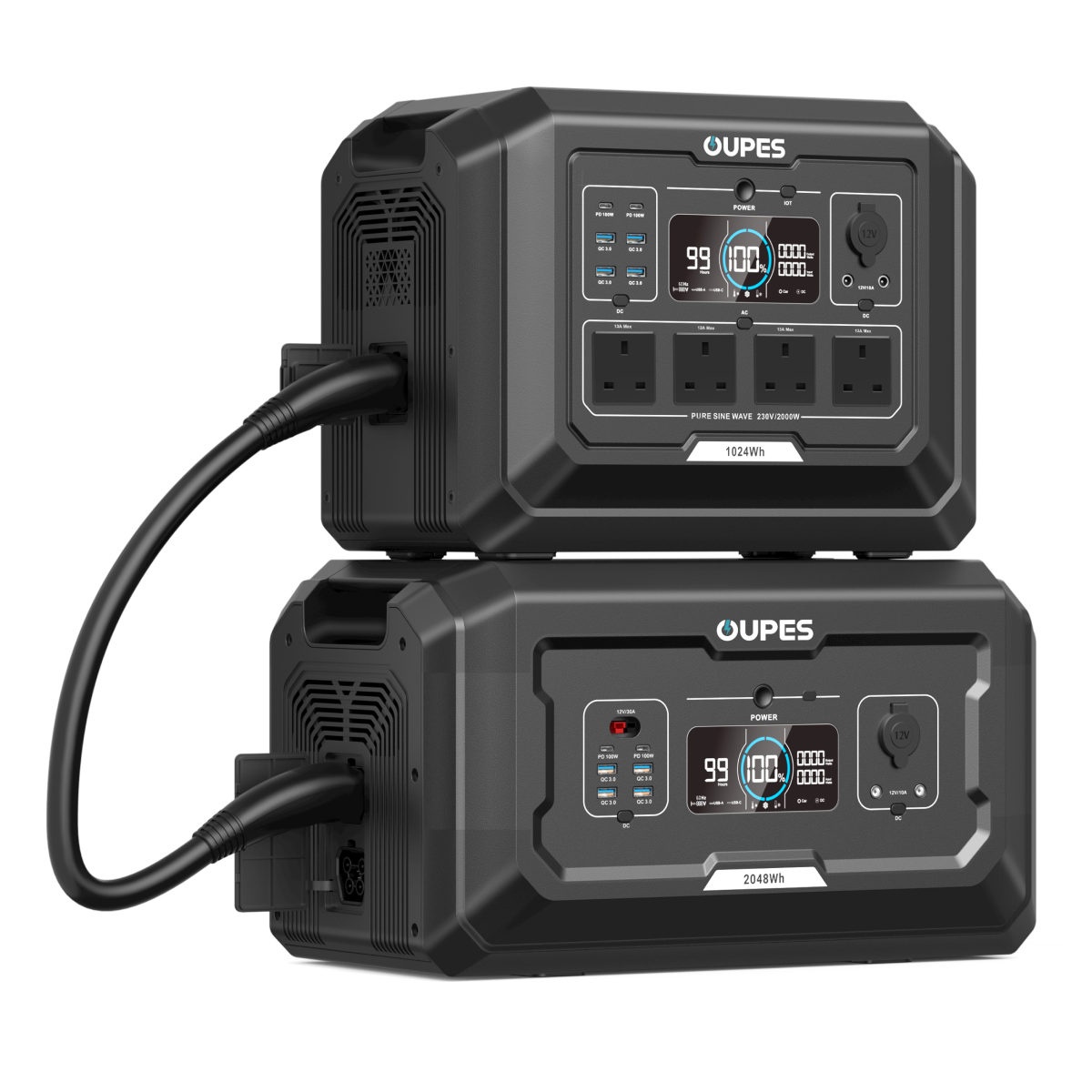
The OUPES MEGA series solar generator bundles are designed to provide stable, predictable runtime across different use cases, making them suitable for both home backup and outdoor scenarios.
Understanding Battery Capacity and Real Usable Energy
Battery capacity is measured in watt-hours (Wh), which represents how much energy the power station can store. However, not all stored energy is usable. Energy is lost during conversion (DC to AC), heat dissipation, and system overhead.
The 80% Usable Energy Rule
In real-world usage, it is practical to assume that about 80% of the rated capacity is usable. This provides a realistic baseline for calculating runtime.
Basic Runtime Formula
Runtime (hours) ≈ Battery Capacity × 0.8 ÷ Device Power (W)
This formula allows users to estimate how long a portable power station can run specific devices under typical conditions.
OUPES MEGA Series Solar Generator Bundles Overview
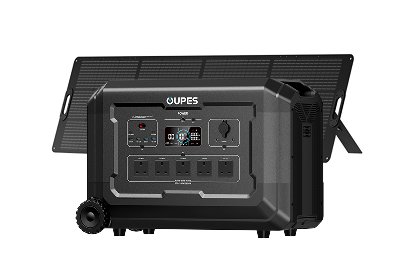
The MEGA series bundles combine high-capacity power stations with solar panels, enabling both energy storage and renewable recharging.
| Bundle | Capacity | Usable Energy (~80%) | Solar Input |
|---|---|---|---|
| Mega 1 + 240W Solar Panel | 1,024Wh | ~819Wh | 240W |
| Mega 2 + 240W Solar Panel | 2,048Wh | ~1,638Wh | 240W |
| Mega 3 + 2×240W Solar Panels | 3,072Wh | ~2,458Wh | 480W |
| Mega 5 + Solar Panels | 5,040Wh | ~4,032Wh | High solar input support |
These bundles provide a range of capacities suitable for different runtime needs, from short outages to multi-day backup scenarios.
Runtime Calculations for Common Household Devices
The following table shows estimated runtimes for common devices using the Mega 2 bundle as an example.
| Device | Power (W) | Estimated Runtime (Mega 2) |
|---|---|---|
| Wi-Fi Router | 15W | ~109 hours |
| LED Light | 10W | ~163 hours |
| Laptop | 60W | ~27 hours |
| Refrigerator | 120W (cycling) | ~13 hours |
| TV | 100W | ~16 hours |
These estimates provide a realistic view of how long a power station can support typical household devices.
Scenario-Based Runtime Examples
Short Power Outage (6–12 Hours)
During short outages, users typically prioritize lighting, communication, and basic comfort. A Mega 1 bundle can easily support multiple lights and a router for an entire evening.
Overnight Outage (12–24 Hours)
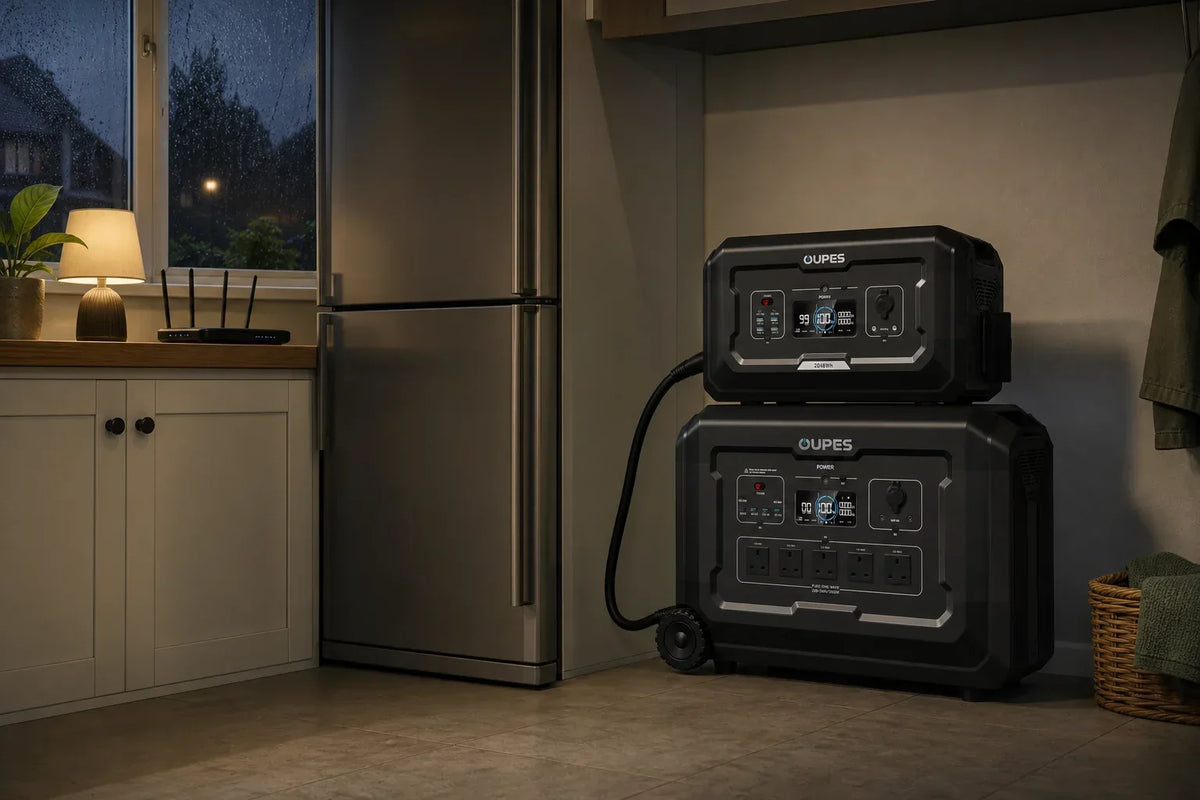
Overnight scenarios often include refrigerator operation and device charging. The Mega 2 bundle provides sufficient capacity to maintain essential appliances through the night.
Multi-Day Outage (2–3 Days)
For extended outages, the Mega 3 bundle offers both higher capacity and stronger solar input, allowing daily energy recovery and longer sustained operation.
Extended Emergency Preparedness
Larger configurations such as Mega 5 bundles provide extended runtime for multiple devices, supporting households through prolonged disruptions.
How Solar Panels Extend Runtime
Solar panels transform a portable power station from a fixed battery into a renewable energy system. Instead of running out after one cycle, the system can recharge during the day.
Daily Energy Recovery
For example, a 240W solar panel under good sunlight conditions can generate significant energy over several hours, partially or fully replenishing daily usage.
Reduced Dependence on the Grid
Solar charging allows users to maintain power even when grid electricity is unavailable for extended periods.
How to Estimate Your Own Runtime Needs
Choosing the right portable power station depends on understanding your specific usage.
Step 1: List Your Devices
Identify the devices you need to power during outages or outdoor use.
Step 2: Calculate Total Power Consumption
Add up the wattage of devices that will run simultaneously.
Step 3: Apply the Runtime Formula
Use the formula: Capacity × 0.8 ÷ Total Load to estimate runtime.
Step 4: Consider Solar Support
If using solar panels, factor in daily energy recovery to extend runtime.
Frequently Asked Questions
How long can a portable power station run continuously?
It depends on the battery capacity and connected load. Larger systems can run for many hours or even days with solar support.
Why does actual runtime differ from advertised numbers?
Real-world factors such as efficiency losses and device behavior affect runtime.
Can a power station run a refrigerator all day?
Depending on capacity, it can support intermittent refrigerator operation for many hours.
Does solar charging significantly extend runtime?
Yes. Solar panels can replenish energy daily, making long-term use possible.
Is higher capacity always better?
Not necessarily. The best choice depends on actual usage needs and portability preferences.
How accurate is the 80% rule?
It provides a realistic estimate for most real-world scenarios.
Can I run multiple devices at once?
Yes, as long as the total power draw is within the system’s rated output.

Leave a comment
This site is protected by hCaptcha and the hCaptcha Privacy Policy and Terms of Service apply.