




Quick Answer
The UK Food Standards Agency advises that a full freezer may keep food frozen for up to 48 hours and a half-full freezer for up to 24 hours if the door remains closed. A fridge may stay cold for up to four hours. These are estimates, so temperature and food condition must guide the final decision.
Keep doors closed, use appliance thermometers and follow current food-safety guidance. A battery backup can preserve cooling only if it handles compressor startup and has enough energy for the refrigerator or freezer’s cycling consumption.
Key Facts
Insulation, room temperature, appliance design, how full it is and door opening all affect the safe window.
| Appliance Condition | Planning Window | Best Immediate Action | Important Caveat |
|---|---|---|---|
| Full freezer, unopened | Up to 48 hours | Leave the door closed | Temperature varies by model and room |
| Half-full freezer, unopened | Up to 24 hours | Group frozen items together | Less frozen mass retains less cold |
| Fridge, unopened | Up to 4 hours | Keep closed and monitor | Perishable food needs prompt assessment |
| Repeatedly opened appliance | Shorter and uncertain | Stop unnecessary checks | Warm air enters each time |
How It Works
A freezer becomes an insulated cold box when power stops. Frozen food absorbs heat as it warms, so a full compartment usually remains cold longer than a half-empty one.
A front-opening upright freezer can lose cold air rapidly when opened. A chest freezer tends to retain cold air better, but the official time windows remain estimates rather than guarantees.
Do not use smell or taste alone to judge safety. Track time and temperature, follow the Food Standards Agency’s instructions and discard high-risk food when safety is uncertain.
How to Plan Freezer Backup Runtime
Measure the freezer’s energy use over at least 24 hours with a suitable monitor. Compressors cycle, so the nameplate watts cannot simply be multiplied by 24.
Estimated runtime = battery rated Wh × assumed usable AC factor ÷ average measured watts. Also verify the inverter can start the compressor. Solar generation during an outage is variable and should not be counted as guaranteed energy.
| Battery Capacity | 100W Average Load | 150W Average Load | Planning Note |
|---|---|---|---|
| 1,024Wh | About 8.7 hours | About 5.8 hours | Uses an illustrative 85% factor |
| 1,488Wh | About 12.6 hours | About 8.4 hours | Other loads reduce runtime |
| 2,232Wh | About 19.0 hours | About 12.6 hours | Compressor startup still must fit |
| 3,072Wh | About 26.1 hours | About 17.4 hours | Actual cycling changes the result |
Compare the Main Options
Preparation should combine passive cold retention and active backup rather than assuming the battery will last indefinitely.
| Action | Benefit | When to Use | Limitation |
|---|---|---|---|
| Keep doors closed | Preserves cold without energy | Immediately | No temperature control |
| Use thermometers | Provides evidence for decisions | Before and during outages | Must be read without frequent opening |
| Battery backup | Maintains compressor operation | When compatible and charged | Finite runtime |
| Move food safely | Protects high-value or high-risk items | Long outages | Requires a verified colder location |
UK Planning Considerations
The Food Standards Agency says a power cut under four hours is unlikely to affect food safety in chilled or frozen storage, while longer outages require temperature-based action. Follow the current page rather than relying on an old rule of thumb.
Prepare a list of local outage contacts, keep thermometers in appliances and know which foods are highest risk. Food safety takes priority over avoiding waste.
For the underlying UK guidance or current figures, check Food Standards Agency emergency food-safety guidance. Published tariffs, standards and safety advice can change, so verify the source again before acting.
Relevant OUPES UK Options
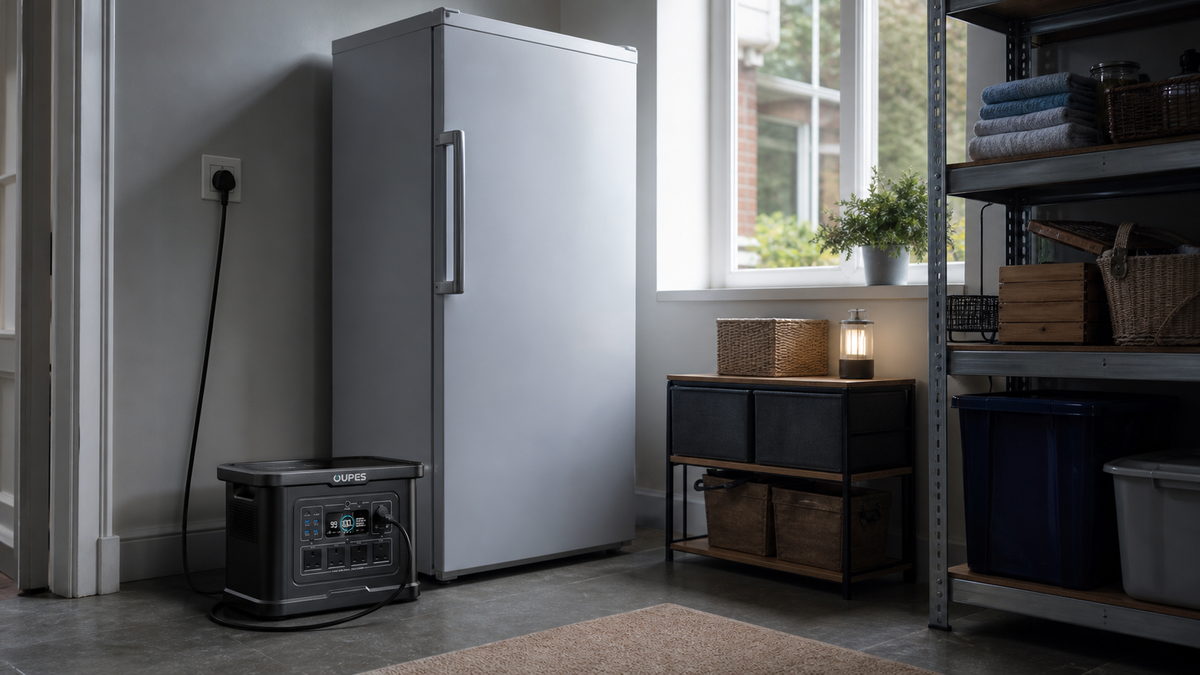
A refrigerator or freezer requires compatible continuous output and compressor-starting capability. Choose capacity from measured 24-hour energy, then reserve stored energy for food protection rather than nonessential loads.
| UK-Site Product | Capacity | Rated Output | Solar | Planning Role |
|---|---|---|---|---|
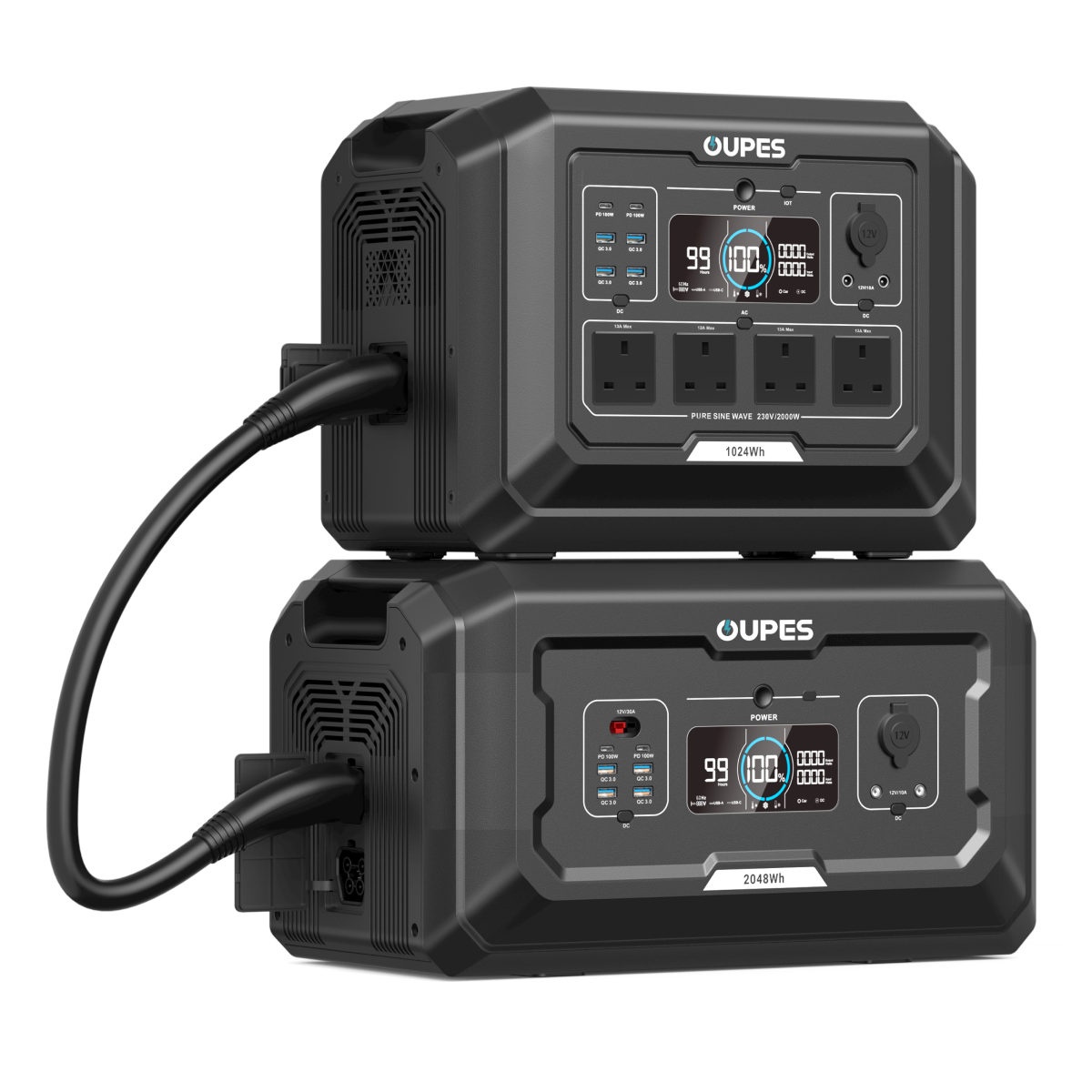
| OUPES Mega 1 | 1,024Wh | 2,000W | Up to 800W | Portable everyday loads and shorter backup sessions |
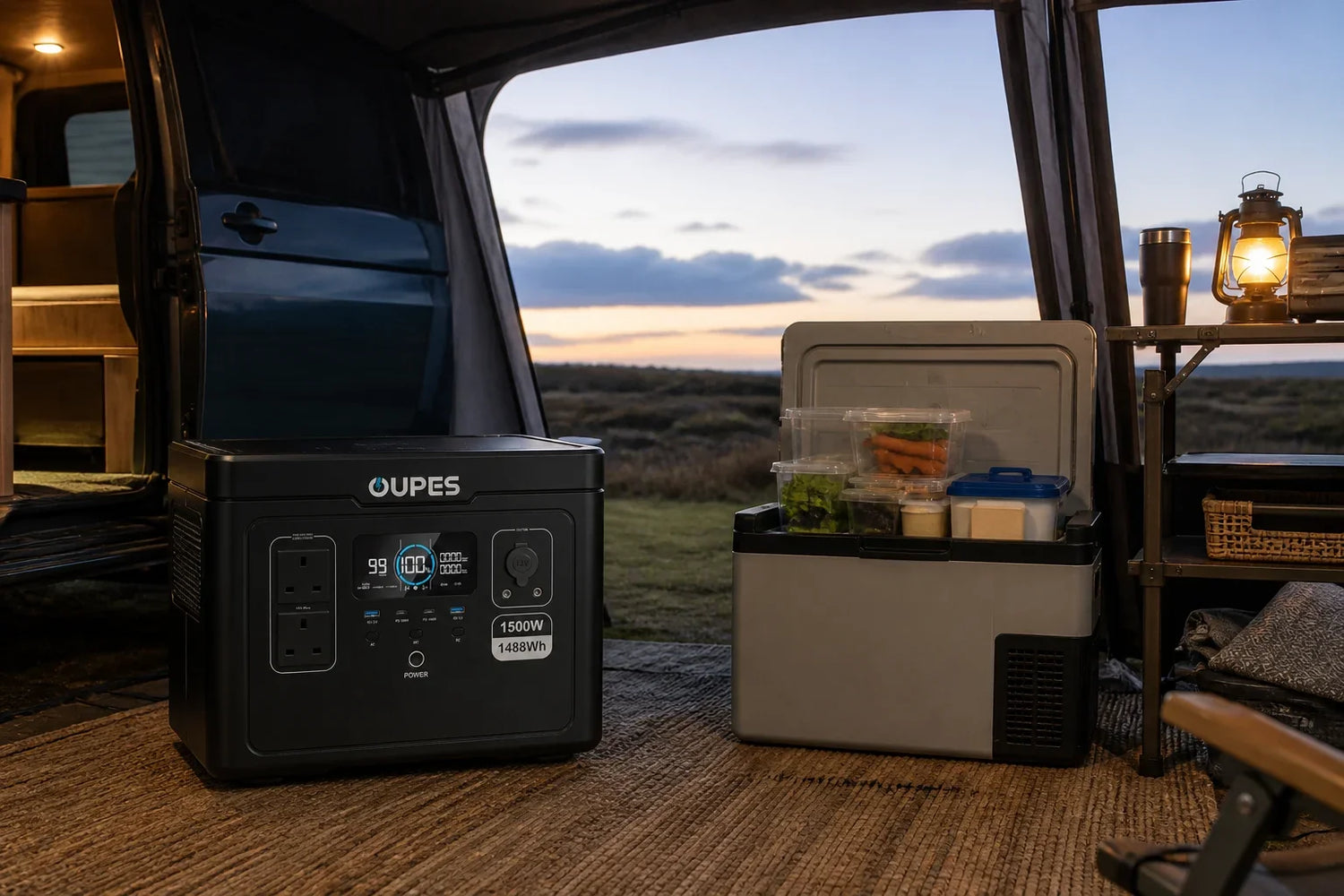
| OUPES Exodus 1500 | 1,488Wh | 1,500W | Up to 480W | Longer low-to-medium-load use where portability matters |
| OUPES Exodus 2400 | 2,232Wh | 2,400W | Up to 800W | Higher energy budgets and compatible higher-power appliances |
| OUPES Mega 3 | 3,072Wh | 3,600W | Up to 2,100W | Large loads, longer backup plans and expandable storage |
Before ordering from the UK store, confirm the current supplied model’s AC voltage, socket format, cables and appliance compatibility on the product page. Do not infer compatibility from wattage alone.
Practical Checklist
Before and during a power cut:
- Keep fridge and freezer thermometers in place.
- Keep doors closed and avoid repeated checking.
- Record when the power failed.
- Prioritise high-risk chilled foods.
- Measure freezer energy use before an emergency.
- Test backup cables and recharge plans safely.
Safety and Limitations
Never use a combustion generator indoors, in a garage or near openings. Carbon monoxide is colourless and can be fatal.
Do not backfeed a home circuit through an improvised lead. Plug an appliance directly into a compatible portable station only as instructed, or use approved transfer equipment installed by a qualified electrician.
Final Verdict
Use 48 hours for a full unopened freezer, 24 hours for a half-full freezer and four hours for a fridge as planning guidance—not guarantees. Keep doors shut, monitor temperature and size backup from measured energy plus compressor startup.
Frequently Asked Questions
1. How long will a full freezer stay frozen?
Up to about 48 hours with the door closed, according to Food Standards Agency guidance.
2. How long will a half-full freezer stay frozen?
Up to about 24 hours if kept closed, although appliance and room conditions vary.
3. How long does a fridge stay cold?
Up to about four hours with the door closed.
4. Can I refreeze thawed food?
Follow current Food Standards Agency advice based on temperature, time and the food type.
5. Can a power station run a freezer?
Yes when its output and compressor surge are compatible and it has enough usable energy.
6. Should I open the door to check?
Avoid unnecessary opening; use a thermometer and record outage time instead.

Leave a comment
This site is protected by hCaptcha and the hCaptcha Privacy Policy and Terms of Service apply.